
The Gion District’s Lanterns and the Neon Pulse of Shibuya
Few cities embody contrast as effortlessly as Kyoto and Tokyo. In one, lantern light pools softly along wooden facades; in the other, neon reflections ripple across glass and asphalt. Together, they reveal a Japan where heritage and hyper-modernity do not compete — they coexist, shaping a rhythm that feels both timeless and forward-looking.
Posts may include affiliate links to products or services. I might earn a commission if you make a purchase.
Japan’s urban landscape resists simple definitions. It is neither suspended in tradition nor propelled solely by futurism. Instead, it moves in dual currents — one grounded in ritual, craftsmanship, and inherited space; the other charged with speed, innovation, and light.
Kyoto and Tokyo form perhaps the clearest expression of this dialogue. In Kyoto’s historic quarters, architecture absorbs memory. Scale is intimate. Movement slows naturally.
Across the country in Tokyo, districts like Shibuya hum with restless energy, their illuminated facades announcing a city that rarely pauses. Yet these two atmospheres are not opposites. They are variations within the same cultural continuum.
To move between them is not to jump from past to future, but to witness how both exist simultaneously — layered, interwoven, and quietly balanced.
Harmonizing heritage with future urbanism

Kyoto settles into the evening without signalling that it has begun. Light thins slowly along tiled roofs. Wood absorbs warmth and releases it gradually. The air carries something faintly sweet — not perfume exactly, not incense either — just the residue of enclosed spaces opening briefly and then closing again.
In Gion, direction feels less important than pace. Streets bend without revealing their length. A shadow moves ahead of you before you recognise its source. The city does not arrange itself for viewing. It continues regardless.
Time gathers here in layers rather than sequences.
Lanterns: More darkness than light

Paper lanterns glow, but softly — more suggestion than illumination. Beneath them, footsteps flatten against stone. Somewhere beyond the narrow lanes, the broader network of Japanese trains continues its low, consistent motion, unseen but present, threading through regions without interrupting this quieter pocket of the city.
Doors slide shut without sound. A bicycle wheel rotates slowly against the curb. Vending machines hum faintly, their light restrained rather than insistent. Nothing feels staged for attention.
Even when you pause, the street does not freeze. It adjusts around you. A curtain lifts. A conversation drifts outward and dissolves again.
Movement & transition

The journey east unfolds without ceremony. Holding Kyoto to Tokyo train tickets means little once the carriage begins to move; the paper becomes incidental. Outside, the scenery rearranges itself in increments too subtle to catalogue — rooftops thinning, fields appearing briefly, then suburbs layering over one another.
Speed exists, but it feels internal, almost private. Reflections in the window overlay faces against the landscape. Tunnels arrive without warning and release light again before you have fully registered darkness.
There is no visible moment where tradition yields to modernity. The shift feels atmospheric rather than geographical. Mountains flatten. Wires multiply overhead. Buildings rise taller, though gradually enough to feel accidental.
Strangely contained neon

Shibuya does not erupt. It gathers. Screens flicker above intersections, yet the brightness feels organised rather than chaotic. The crossing fills and empties in measured waves. Umbrellas tilt slightly in unison when rain begins.
Sound layers rather than spikes — announcements, footsteps, low music filtering from a storefront. Glass reflects movement onto itself. The city hums but does not shout.
Even here, there are moments of stillness. An escalator pauses briefly between cycles. A side street narrows unexpectedly. A convenience store door slides open and closed with the same softness as a wooden door in Kyoto.
Between lantern shadow and neon surface

Later, the distinction between lantern and LED blurs. Warm paper light overlaps faintly with digital glow. The scent of wood lingers alongside the metallic air of underground stations. Narrow alleyways align in memory with broad pedestrian crossings.
It becomes difficult to say where one atmosphere ended and another began. The train journey folds into both. Reflections in carriage windows feel similar to reflections in Shibuya’s glass towers — interior layered against exterior, neither fully dominant.
What remains is not contrast, but adjustment. Light shifting tone. Pace recalibrating without rupture.
And somewhere between lantern shadow and neon surface, the movement continues quietly — not replacing, not resolving — simply unfolding across districts that carry past and present without insisting they stand apart.
Reflections replace certainty
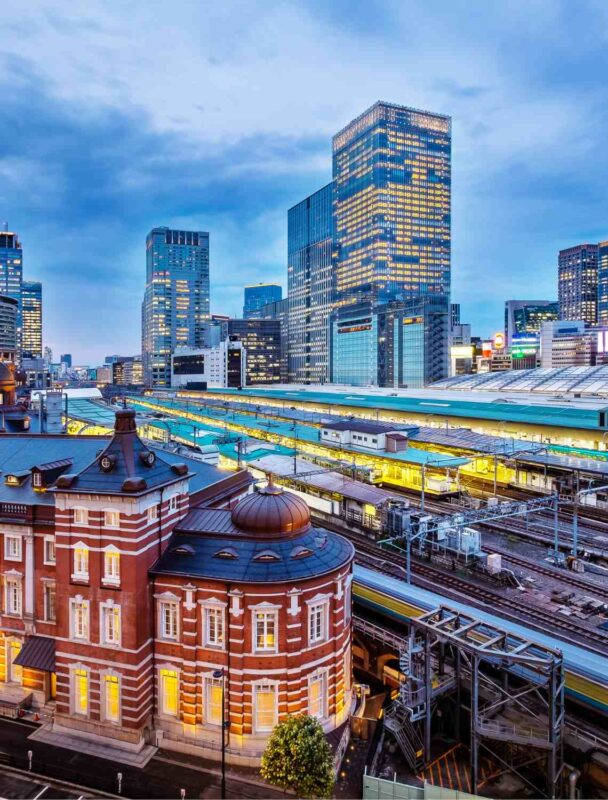
There are moments when the train window feels more substantial than the view beyond it. Interior light rests faintly over fields, then over suburbs, then over the first suggestion of skyline.
The layering makes distance harder to measure. Faces hover against mountains. Overhead luggage racks appear superimposed on rice fields. You are somewhere between places, but also momentarily nowhere in particular.
The reflection lingers even after arrival. Glass towers in Shibuya repeat the same effect, doubling the city against itself. Neon glows once in the air and again in polished façades.
Even in Kyoto, where surfaces are softer and less reflective, lantern light pools faintly against wooden panels in a similar way — contained, but layered. The boundary between interior and exterior never feels entirely secure.
A pause

In Gion, evening does not arrive; it accumulates. The light thins along rooflines. Shadows deepen between wooden beams. Conversations soften further, though no one signals the change. Lanterns glow more clearly against the dark, yet they do not flare. They hold steady.
In Shibuya, night behaves differently but not dramatically. Screens brighten. Crossings fill and empty in measured waves.
Rain, when it falls, does not scatter the crowd but reorganises it — umbrellas rising in quiet coordination. Neither district insists that this is the defining hour. Time slides forward without announcement.
Space between footsteps

Stone in Kyoto and pavement in Tokyo respond differently underfoot, yet the sensation of movement remains consistent.
In Gion, footsteps compress slightly against worn surfaces that have absorbed repetition for centuries. In Shibuya, rubber soles move across crosswalk stripes that renew themselves with each signal change.
Crowds gather and disperse in both places. A narrow lane in Kyoto opens briefly into a small square before closing again. A side street in Shibuya thins into residential quiet within seconds. Overhead, wires intersect against a sky that feels unexpectedly similar across cities — pale, open, unassertive.
The scale shifts. The rhythm does not.
Light after you leave

Later, memory refuses to separate the paper lantern from the LED screen too precisely. The warmth of one overlaps faintly with the brightness of the other. Train platforms blur with alleyways. The metallic hum of a departing carriage aligns strangely with the softer slide of a wooden door.
The journey itself feels less like transit and more like a thin thread connecting quiet wood and reflective glass. Even after leaving, you carry the calibration with you — adjusting instinctively to brightness, to shadow, to pace.
And somewhere along that thread, light continues — soft in one place, electric in another — neither cancelling the other out, simply coexisting in a rhythm that never quite resolves, never quite declares which era belongs to where.
As if the cities themselves prefer to remain slightly unfinished, held in balance between glow and shadow rather than fully defined by either.
Pin for later!

Pick a section to read more:


About me:

I have lived in Chania, Crete, since 2016. As a local, I have an intimate knowledge of the island. I host culinary and concierge tours and experiences in Crete and write about the island for several travel media. I have helped many travelers plan the perfect holiday in Crete. I co-authored DK Eyewitness Top 10 Crete and had more glasses of frappe than any regular person could ever handle.